




“So how do you pronounce your name?”
“It’s Ryo in English, and りょう in Japanese.”
This is a conversation I have almost every time I meet someone new. My name, while spelled Ryo, actually reads as “Rio” in English. And it has such a totally different pronunciation in Japanese that I cannot even spell it out with the Roman alphabet. Ever since I moved to Tunisia at age three, I have had the two different pronunciations of my name, one in English and one in Japanese.
Growing up, the two different pronunciations of my name have been a symbol of the two language worlds I live in. Born in Japan, I moved to Tunisia and started attending an American school at age three. At school, I was “Ryo,” the quiet and shy student who cried often. At home, I was “りょう,” the talkative girl, living in her imagination and fantasies. On weekdays, going to school, I would not only switch to English, but I would switch into “Ryo.” On weekends, as I spent time with my family or Japanese friends who attended other schools, I would become “りょう.” The two names not only separated my two language worlds, but they also created two different personalities. And growing up, I kept developing two separate and very different personalities. Or I believed so.
The two names not only separated my two language worlds, but they also created two different personalities.
I repatriated to Japan after three years in Tunisia, and my daily life got filled with Japanese. “りょう” was trying hard to navigate the expectations in Japan, speaking Japanese and trying to match her Japanese peers. With the emotional labor to fit in, I obsessed over my “Ryo” self to establish something I was different from others. “Ryo” was the reason why I didn’t fit in. I adjusted “りょう” so I could be accepted. But internally, I relied on the fact that “Ryo” was always there, so I could be unique, and I had an excuse for not fitting in.
So as I led a globally mobile childhood, code-switching has played a huge role both in my day-to-day life, as well as in major transitions. It helped me navigate different school systems, from an American school in Tunisia, to a public school in Japan, to an international school in Vietnam. I not only spoke different languages but switched my personality accordingly. Linguistically, code-switching is defined as “the ability on the part of bilinguals to alternate effortlessly between their two languages” (Bullock and Toribio 1). In our everyday life, code-switching is often referred to as the ability to switch between different codes, behaviors, ways of talking, etc., to match the situation.
From home to school, to friend groups and different countries, I would switch back and forth between Japanese and English, as well as my “Ryo” self and my “りょう” self. While I absolutely loved my life as a TCK growing up in different countries, there was always a part of me thinking, I’m never showing my full self anywhere. No matter where I was, I felt like I was having to “create” another version of myself. In an English context, I would develop my “Ryo” self to match the community. Same goes for Japanese contexts with “りょう.”
So who am I? Am I “Ryo”? Or “りょう”? The question constantly came up in my mind. I have gotten very good at code-switching and navigating different language worlds, but where can I express myself as a whole? Is that even possible?
These questions intensified as I started attending college in the US. For the first time, the lines between my language worlds got blurred. I met people who spoke both Japanese and English. I was often in groups where some knew me as “Ryo” and others knew me as “りょう.” Living on campus, my “home” and “school” were no longer separated either. Before college, the different codes I was navigating were very obvious. The clear boundaries of my language worlds meant that I could maintain “Ryo” and “りょう” pretty much separately, with ease. But now, I was in spaces where some people knew both sides of me. I struggled with my new situation, getting more and more confused about who I was.
I have gotten very good at code-switching and navigating different language worlds, but where can I express myself as a whole? Is that even possible?
This was when I encountered the term “code-meshing” in my rhetoric class. Coined by Vershawn Ashanti Young, code-meshing is an act of blending “dialects, international languages, local idioms, that-room lingo, and the rhetorical styles of various ethnic and cultural groups in both formal and informal speech acts” (Young 67). While the definition closely aligns with the definition of code-switching, code-meshing puts emphasis on the mixing of codes, instead of seeing them as distinct things that you need to switch between. Learning the concept and seeing it in practice through his paper liberated me. My professor who introduced me to this term was open to me writing in Japanese and English at the same time. My languages were embraced as assets, and I had a platform to experiment with them. For the first time, I saw my language worlds merging in a positive way.
Through this experience, I also started to come in terms with my identity. I’m not either Ryo or りょう, but I am both. Even after realizing this, I went through phases where I considered just using one of the pronunciations, so that I have a clear answer to the question, “What is your name?” But in the end, I realized that it does not matter. Some people can call me Ryo and others can call me りょう. I might even discover other pronunciations when I learn new languages. And that is OK. I can choose to code-mesh when I want to. But altogether, I am one person.
I can choose to code-mesh when I want to. But altogether, I am one person.
The more I learned about code-meshing, the more comfortable I got speaking with people around me. I started embracing dialects and accents I have as well. I speak two dialects in Japanese, but I almost never revealed it to others for fear of breaking the image that others have of me. One dialect was only used within my family, since I only lived in the area that uses that dialect for a year in my life. Now, I use it all the time, and I sometimes mesh it with other dialects and languages I speak.
Code-switching remains an important part of my life, but now I can see that the different codes I am navigating are all parts of me. And I can choose to mesh them fluidly as well. I have code-meshed in papers and presentations at college, and received overwhelmingly positive comments that I never anticipated. Through my transition from code-switching to code-meshing, I have found my voice. I found a way to be both Ryo and りょう.
References
Bullock, Barbara E. and Almeida Jacqueline Toribio. “Themes in the Study of Code-switching.” The Cambridge Handbook of Linguistic Code-switching, edited by Barbara E. Bullock and Almeida Jacqueline Toribio, Cambridge University Press, 2009, pp. 1-18.
Young, Vershawn Ashanti. “Should Writers Use They Own English?” Writing Centers and the New Racism: A Call for Sustainable Dialogue and Change, edited by Laura Greenfield and Karen Rowan, Utah State University Press, 2011, pp. 61-72.
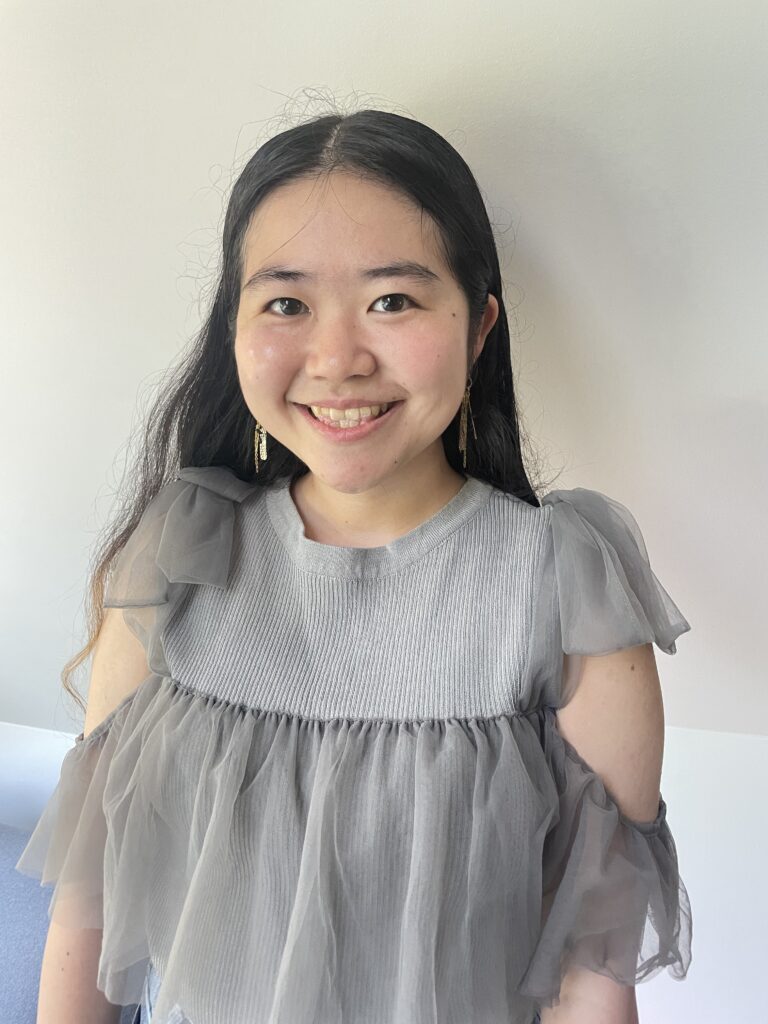
Ryo Adachi (she/her) is a TCK who grew up in Japan, Vietnam, and Tunisia. She then attended a college in Ohio and got a job there, spending a total of 8 years (the longest she’s been in one town!). Ryo is now based in Tokyo, where she works in education, her passion. She is passionate about linguistic diversity and equity and is invested in helping students overcome language barriers in education.