

This week, Daniel Stone attempts to articulate the emotions that ran through him after finding out that his childhood home would soon be torn down. For anyone, the physical things of our childhoods play an important role in shaping us into who we are but for many TCKs these pieces of our childhood are now things and places that we are unable to return to. Read along as Daniel process this future loss and ultimately comes to the conclusion that sometimes sacrifice and letting go isn’t just something we have to quietly accept, sometimes we’re allowed to take it kicking and screaming.
I have an oddly distinct memory from my childhood in the Philippines. I was very young and I don’t really know why I remember it. It was at church. A little girl, carried by her father, went kicking and screaming to the communion table. She and her family were in the front row, so they were the first to the feast. The band hadn’t started playing yet, so there was nothing else for us to do but watch the scene play out. She protested with the stamina only a child can muster, the kind of anger that is pure, not yet dulled by the long injustices of the world. The world is full of cruel circumstances and there is little to do but to kick and scream at it, to throw a tantrum, to lash out, to let it be known that you are alive.
In the summer before my senior year of college I received word that my childhood home would be affected by a government train project. I was well immersed in my college life in the US, the initial shock of a new culture behind me. I hadn’t thought about that home very much, mainly because I never thought that my childhood home would ever go away, let alone be completely torn down. I felt devastated, and oddly, less Filipino, the kind of way I think Peter felt when he was told he couldn’t return to Narnia. He wasn’t less Narnian, as the quote goes he never stopped being a king of Narnia, but the inability to return certainly puts to question many of those thoughts.
Kurt Vonnegut once said, “What people like about me is Indianapolis.” Admittedly, he said this in Indianapolis, his hometown, in a speech to others from Indianapolis. I like that phrase. It is very hard to separate yourself from where you have come from, the places you have called home; they have shaped you, for bad, but also for good.
Very soon, my childhood home will be gone. In the landscape of my upbringing, I tend to think of the Philippines as the Garden, and the journey to the US as the fall. The culture shock that came with the move taught me that the world was darker than I dreamed. That doesn’t mean I wouldn’t have grown aware of such things had we stayed in the Philippines. However, the dividing line of childhood (Eden), and adolescence (exile), seems, in the mirky way we make sense of our stories, easier placed between the two locations. That home in the Philippines is for me a physical representation of God’s unfailing faithfulness to me and my parents. And the physical representations of abstract things – whether it’s a blankie that reminds you of childhood innocence or the act of packing years of one’s life into small boxes – are hard to go through and let go of.
I am reminded of something said by Jason Reynolds. He was asked if there is anything in his life that feels like praying. He explained that he is taking care of his dying mother: “It is burdensome sometimes, but it also feels like prayer. I’m praying at the only creator that I’ve ever actually physically known,” he continued, “It is me acknowledging the vessel that has given me everything that I’ve become.”
The news about home feels similar to this, “acknowledging the vessel that has given me everything that I’ve become.” That place has always been my, “somewhere I belong.” And soon it will be gone. Very soon my childhood home will be gone. And this all feels like prayer. So many people exist in that space that have loved me into the person I am today. That is very spiritual. God works through opportunities and cruel circumstances, through culture and coincidence; most of all through people and place. God has used that childhood place abundantly and creatively, it represents a part of the great creator that has played a major role in my development. I am bowing down at the cross of the creator that I have fully experienced and known. What is about to be crucified is the place that has made me who I am, all the different versions I have been before this one. And crucifixion hurts. O Father, is there no other way?
“If it is not possible for this cup to be taken away unless I drink it, may your will be done.”
So now I am beginning my last year of college and I am kicking and screaming and throwing a tantrum. I’m here at the feast with nowhere to hide. This cup poured out for me is hard to stomach. I can kick and scream, but I am still carried there regardless. And perhaps, that’s the only way to go about it. Because the little girl, of course, had things the right way round, there is no other more reasonable way to go to the table than kicking and screaming and – perhaps most importantly, carried.
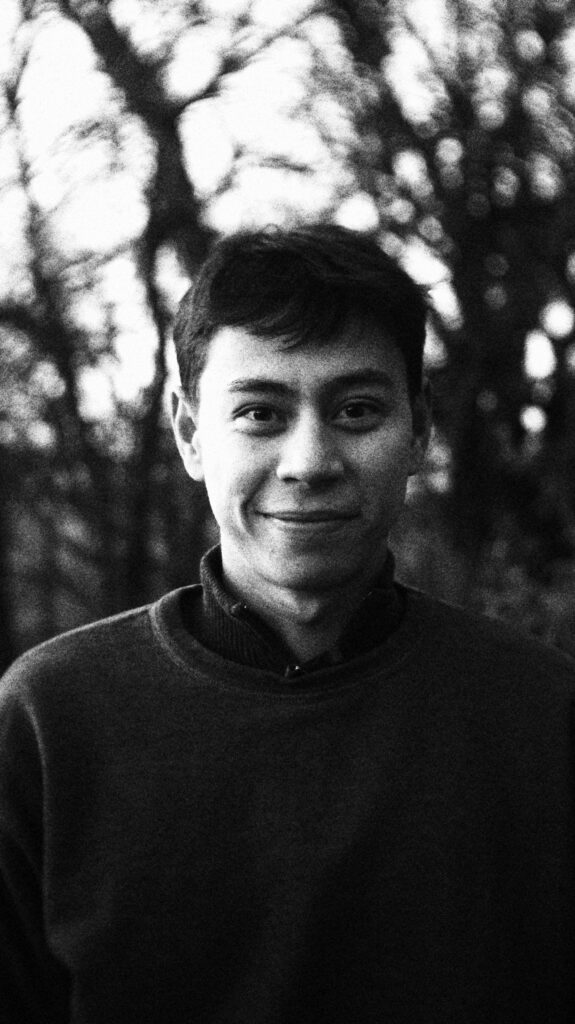
Daniel Stone grew up as a missionary kid in the Philippines. He is currently a senior at Sterling College where he is earning his degree in psychology.